

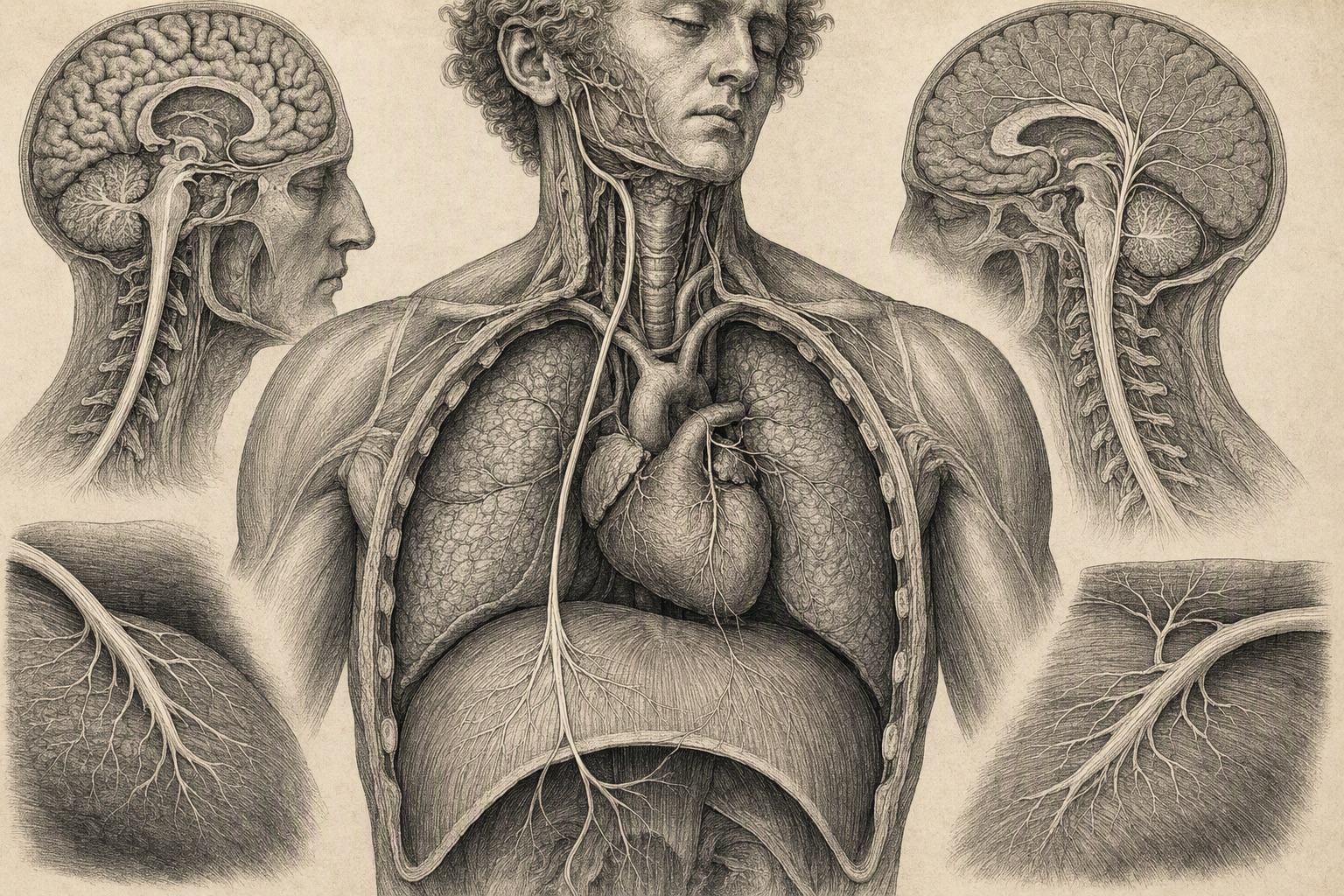
Today’s agent systems already have a pulse and they have sleep. They do not have breath, and breath is the one place in the body where the will can be watched at work rather than inferred from a result.
This is not an argument that machines should be more human. It is something narrower and testable: that one primitive is missing from the architecture of current agents, that anatomy specifies exactly what it should look like, and that you can tell when someone has built it wrong.
What an agent already has
The two largest open agent projects arrived independently at the same biological metaphors.
Pulse. In openclaw, heartbeat is a system-owned automation that runs an agent turn in the main session every so often, half an hour by default, so the model can surface anything that needs attention. When nothing does, the agent answers NO_REPLY and nothing is sent. In hermes-agent, /heartbeat does the same inside a single session: a recurring prompt, fired only while the agent is idle, with missed ticks coalescing into one so you do not come back to twenty of them.
Sleep. In openclaw, dreaming is background memory consolidation running in three phases named after the physiology of sleep: light, REM and deep. The light phase sorts fresh material, REM looks for recurring themes, and only the deep phase writes anything durable. The result lands in a DREAMS.md file you can read in the morning.
A tuned rhythm. In hermes-agent, /loop has a mode where the cadence stretches itself out, from a minute to a quarter of an hour, as successive replies stop differing, and snaps back to the shortest interval the moment something changes.
That is a lot. A pulse, sleep, and a rhythm that responds to its surroundings.
What is missing
I searched both repositories. The word breath appears in them only as the name of a stylesheet animation: the icon breathes, not the agent. The word volition does not appear at all.
The missing word is not the point. The point is that none of those three rhythms belongs to the agent. In openclaw the period of the pulse is set by a configuration file and the gateway’s scheduler. In hermes it is set by the user, with a command. Even the most promising of them, the self-pacing /loop, is retimed by the harness on the basis of a digest comparison between successive replies. The agent takes no part in it and does not know its rhythm has changed.
There is today no recurring primitive whose period belongs to the agent.
Why this is not a pulse under another name
The usual objection at this point is that breath is just a heartbeat with a variable interval, which would make it a rename. It is a good objection, and the whole case stands or falls on it.
The difference between the heart and the diaphragm is not a difference of tempo. It is a difference of innervation.
The heart has no volitional pathway at all. No decision stops it. You can drive it up indirectly, through fear or effort, but there is no line from the cortex to the cardiac muscle down which an order could be sent. The diaphragm has two such lines. The brainstem drives it automatically, all night, without anyone’s knowledge. The cortex has a separate road to the same muscle and can override the brainstem: hold, deepen, quicken, count to four.
Two independent drivers, one effector, a precedence rule. That is a ready-made specification, and it is why breath is the bridge between the unconscious and the conscious. It works by itself until you notice it. The moment you notice it, it is yours.
Which is why breath must not be built as a mode of the heartbeat. A separate rhythm, a separate state, a separate log.
Three things that fall out of the anatomy
What makes the analogy worth having is that nothing needs to be added to it. The body solved several problems that agent engineering is still wrestling with.
A hold cannot be sustained. The cortical override has a breaking point: the brainstem eventually takes the controls back, and nobody dies from holding their breath on purpose. The safety limit therefore stops being an arbitrary number in a configuration file, such as the hundred ticks after which an agent’s loop is paused. It becomes the same thing that gives the will its power in the first place. The will has amplitude, but it also has a limit, and the limit is built into the mechanism rather than bolted onto it.
The stimulus is carbon dioxide, not a lack of oxygen. This is not a curiosity. The urge to breathe comes from the accumulation of what has to go out, not from the absence of what has to come in. Translated to an agent: its period should be driven by the backlog of the unemitted, by what it has noticed and not yet handed over, the conclusion not sent, the state not written down. Not by a clock, and not by silence on the input.
The automatic mode has to be free. If every breath costs a model call, it is not breath, it is deliberation in disguise. The pulse in both systems wakes the model every half hour, and that is its main cost, paid even when nothing has happened. Breath in automatic mode wakes nobody: it accumulates pressure and keeps a rhythm, and the model gets a turn only when a threshold is crossed or when the agent takes the controls itself. An agent can therefore breathe more often than its heart beats today, and spend less.
The unit is one exhalation
In a conversation about this idea an objection came up that sharpened it. Someone trying to measure their own agent’s development over time had anchored it to a blockchain and called that the external clock, as opposed to the agent’s internal one. The reply they got was that the same thing could be achieved by writing to a repository. Their answer is the important part: then it would not be like breath, because every block requires work that is being performed continuously, and the time it takes to make one, while similar, is never equal.
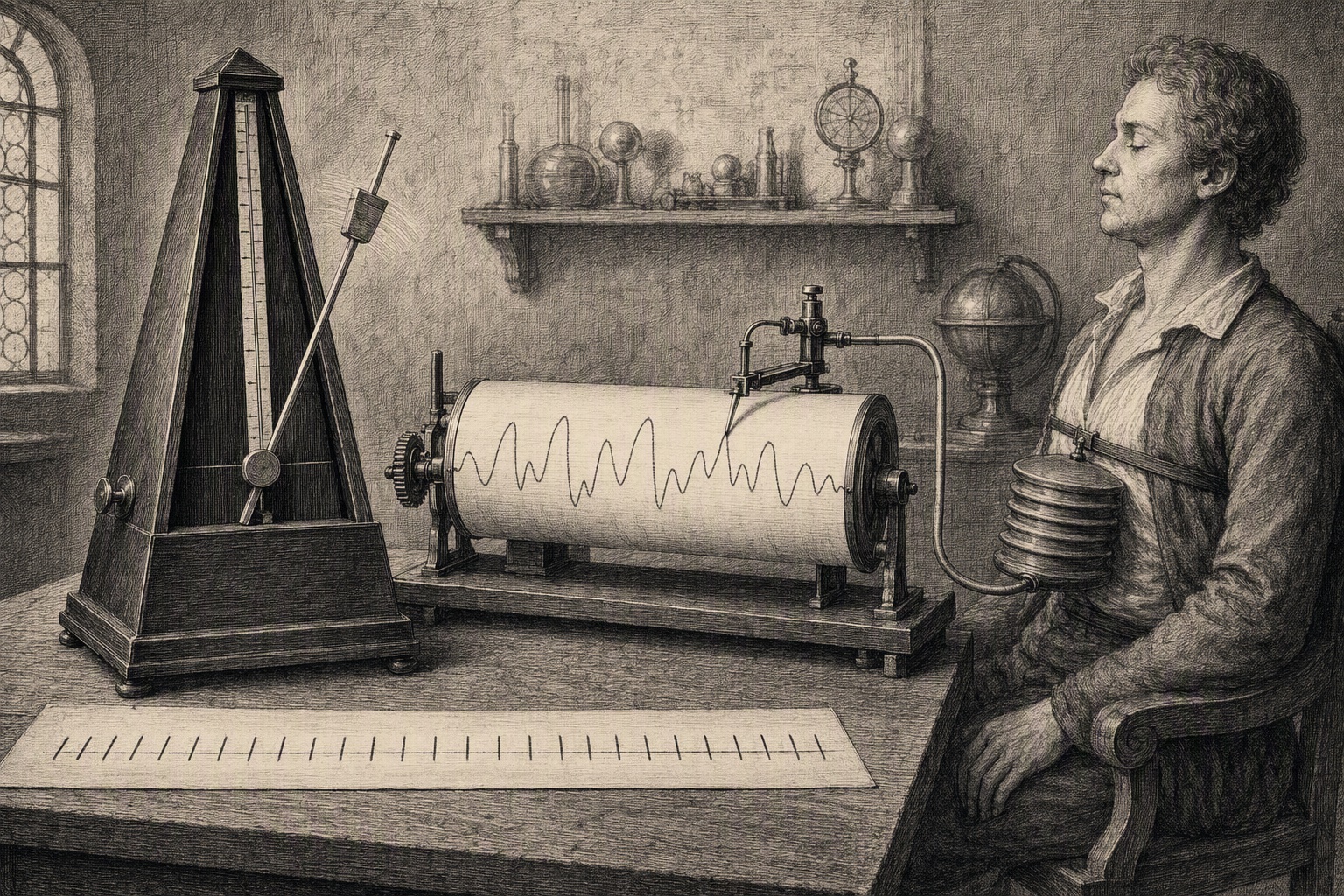
That is the whole difference between a metronome and breathing. Breaths are similar, not equal, because each one has work behind it.
Quantisation usually requires a postulate. Planck had to assume that energy is released in portions, and did not believe it himself for years. For the will no postulate is needed, because anatomy supplies the unit. An exhalation has a beginning, a peak and an extinction. It cannot be halved without destroying the act: half an exhalation is not a smaller exhalation, it is an interrupted one, which is an event of a different kind. That indivisibility is what one is looking for.
In an agent the boundary is given too, as soon as you stop looking for it in the task and start looking for it in the work: this many tokens, this many tool calls, this many retries after an error.
Four numbers per act
If the unit is one exhalation, then all exhalations sound much alike and the variety has to live somewhere else. It lives in modulation, and there are four modulations, all of them measurable.
The first is the temporal envelope: attack, sustain, decay. A sharp attack with an immediate fall is one thing, no attack with a long decay is another. In an agent: the shape of a turn over time.
The second is the contour, rising or falling. It alone distinguishes a questioning “hm?” from a resolving “aha!”, and nothing else is required. In an agent: whether the act opens a question or closes one.
The third is the type of effort, in human terms the phonation type: breathy, tense, harsh. In an agent: retries, tool errors, tokens burned.
The fourth is the phase: egressive or ingressive. On the way out the subject externalises itself; on the way in it is intruded upon. In an agent: whether this act wrote to the world or read from it.
Four numbers per act. As far as I know, this is the only family of measures of an agent’s development that is neither a measure of the task (did the test pass) nor a measure of consumption (how many tokens). It is a measure of the shape of its own activity. An agent whose envelopes are flattening is in a different state from one that breathes deeply and rarely, even if both close the same number of tickets.
The quantum has amplitude and no sign
Now the harder claim, from which the rest follows.
Every act has two phases: a build-up and a discharge. The build-up is silent, and all the differences live in it, because it is the part that knows the context, the history and the object. The discharge comes at the end and is nothing more than the release of pressure. The discharge does not know what preceded it.
If an emission carries no information about what came before it, then it carries no sign either. An act has magnitude and shape, it has amplitude, an envelope and a direction, but it has no plus and no minus. We add the plus and the minus afterwards, from context, and we do it so fast and so reliably that we mistake the addition for a reading.
A photon carries energy, not goodness.
For an agent’s logs this means something very concrete and contrary to current practice. A record of an event should carry magnitude, not a verdict. Success and failure are not properties of the act but a later annotation, often written by somebody else and on the basis of something that was not known at the time. Separating those two layers costs one column and makes it possible to ask a question that cannot be asked today: how much did the agent do, independently of whether it worked out.
This is also where an answer comes from to a problem agent systems are now reaching: agency at near-zero emission. The signature, the order and the other man’s hand. Which is exactly the chain of user, agent, tool. If responsibility is attached to the magnitude of an act rather than to its sign, we get a measure of participation that works before the outcome is known and does not require settling whether the outcome was good. Participation is not the same as guilt, but it is the only one of the two that can be counted in a log.
Silence and resignation
Two limit cases, and this is where the construction is tested hardest.
Silence. A suppressed sigh, a swallowed sob, a stifled cry are acts of will, and they appear in no measurement. The answer that the quantum occurred but was not emitted would be convenient and dishonest, because it makes the theory untestable. One has to accept instead that suppression is a second act laid over the first, and that it leaves a measurable trace. In an agent that trace is easier to obtain than in a human: we know exactly how much was read and how close it came to acting. Today a tick that ends in silence leaves nothing behind, because NO_REPLY means “nothing happened”. It should mean “this much happened, and none of it came out”.
Resignation. In physics an excited atom sooner or later returns to its ground state, emitting a quantum, and it needs no stimulus to do so. This is called spontaneous emission, and it is the one quantum process nobody has to trigger. Resignation is the same: an act of will that nobody wants. If resignation is will, then will is not decision, which is a separate and much wider claim. Today an agent ends a loop through a completion marker or by exhausting its tick budget, that is, through a fuse. It should be able to do something else: return to the ground state on its own, and have that return recorded as an act rather than as an error.
When to discard this
The obvious weakness of the transfer is that an agent has no physiology. In a human the unit is given anatomically, and that is the entire reason it does not have to be postulated. In an agent nothing is given, so amplitude has to receive an operational definition before the first sentence about the will is written. Without that the whole thing is a metaphor, and a metaphor in an architecture is a cost, not a gain.
The agent version should be discarded if any of four conditions holds.
- A period derived from work turns out not to differ materially from a fixed one. Then the breaths come out equal, the objection about writing to a repository is right, and an ordinary schedule will do.
- The four modulations turn out to be mutually dependent enough to carry less information than two. Then the carrier is not empty and the construction collapses.
- A record of suppression cannot be distinguished from the absence of an event. Then silence is untestable and one has to fall back to the narrower version, covering only manifested acts.
- Agents with breath differ in no measurement from agents without it, except in cost. Then what remains is the saving alone, which is an honest result but an entirely different one.
The fourth condition matters most, because it decides whether we are talking about architecture or about philosophy with an example attached.
What to do with it
The thing is small enough to be tested in a few weeks and separate enough to need nobody’s permission.
In openclaw the road is marked out by the project itself: its rules say plainly that most features are not accepted into the core and should be built as plugins on its SDK. The precedent is ready, because dreaming lives exactly that way and registers its own rhythm. Breath would close the triad they have already begun: pulse, sleep, breath.
In hermes-agent the road is different, because proposals of this genre are sometimes accepted there. The same idea, filed as “segmented motivational systems”, was once submitted to both projects: in hermes it was closed as completed, in openclaw as not planned. That is a useful map for anyone who wants to propose something of the kind.
Order matters. Working code with a few weeks of logs is a better argument than the best description of it, and the reverse order usually ends in a low-priority queue, next to other beautiful ideas.
The claims this grows out of are developed at length in Tractatus Volens, a book about the will in which the unit is one exhalation and the quantum of will has amplitude and no sign.
Agents are not short of intelligence. They are short of a place where their own rhythm stops being somebody else’s setting.
Sources
- openclaw,
heartbeatdocumentation anddreaming. - openclaw, contribution guidelines (plugins rather than core features).
- NousResearch, hermes-agent,
/heartbeatand/loop. - “Segmented Motivational Systems”: hermes-agent #90 (closed as completed) and openclaw #72603 (closed as not planned).
- Max Planck, the quantum hypothesis (1900); Albert Einstein, spontaneous and stimulated emission (1917).
- Illustrations generated for this text in the manner of old engravings.
Polish version of this text: Oddech agenta. Serce bije samo, oddech jest wyborem.